Vitamin C in a Tropical Climate
Stability, timing and sun. Why the same serum behaves differently in Bangkok than it does in Lyon, and how to get the antioxidant benefit you paid for.

Vitamin C is the most requested active in professional skincare and the most misunderstood. Part of the confusion is chemical, because the word covers a family of very different molecules. Part of it is geographical. A serum formulated in a European laboratory, tested in a European climate and stored in a European bathroom does not behave the same way in a flat in Sathorn in April. Heat, humidity, light and a high UV index change the arithmetic. The molecule does not care where you bought it, but it cares a great deal about how it is kept and when it is used.
The family, not the ingredient
L-ascorbic acid is pure vitamin C. It is the form the skin can use immediately, without conversion, and it is the form with the deepest body of published research behind it. It is also the least stable molecule in the category. It is water soluble, it requires a low pH to penetrate, and it begins to degrade on contact with oxygen, warmth and light.
The derivatives exist to solve that fragility. They are ascorbic acid with something attached, a phosphate group, a glucose molecule, a fatty acid chain, so that the molecule holds together in the bottle and converts to active vitamin C once it is in the skin. The common ones you will see on an ingredient list include sodium ascorbyl phosphate, magnesium ascorbyl phosphate, ascorbyl glucoside, tetrahexyldecyl ascorbate and 3-O-ethyl ascorbic acid.
The trade is straightforward. L-ascorbic acid offers the strongest and fastest antioxidant effect and the shortest useful life. Derivatives offer stability, gentleness and a neutral pH, but they rely on your skin performing the conversion, and the conversion is rarely complete. Neither choice is wrong. In a tropical climate, the case for a well made derivative is stronger than the marketing usually admits.
"L-ascorbic acid is not a better ingredient than its derivatives. It is a more demanding one, and demanding ingredients need conditions you can actually provide."
What the colour is telling you
A fresh L-ascorbic acid serum is clear, or very faintly straw coloured. As it oxidises it turns yellow, then amber, then a deep orange brown. The colour change is the ascorbic acid converting to dehydroascorbic acid and then to further breakdown products, chief among them erythrulose, which is a self tanning agent. This is why a badly oxidised serum can leave a faint orange cast on the skin.
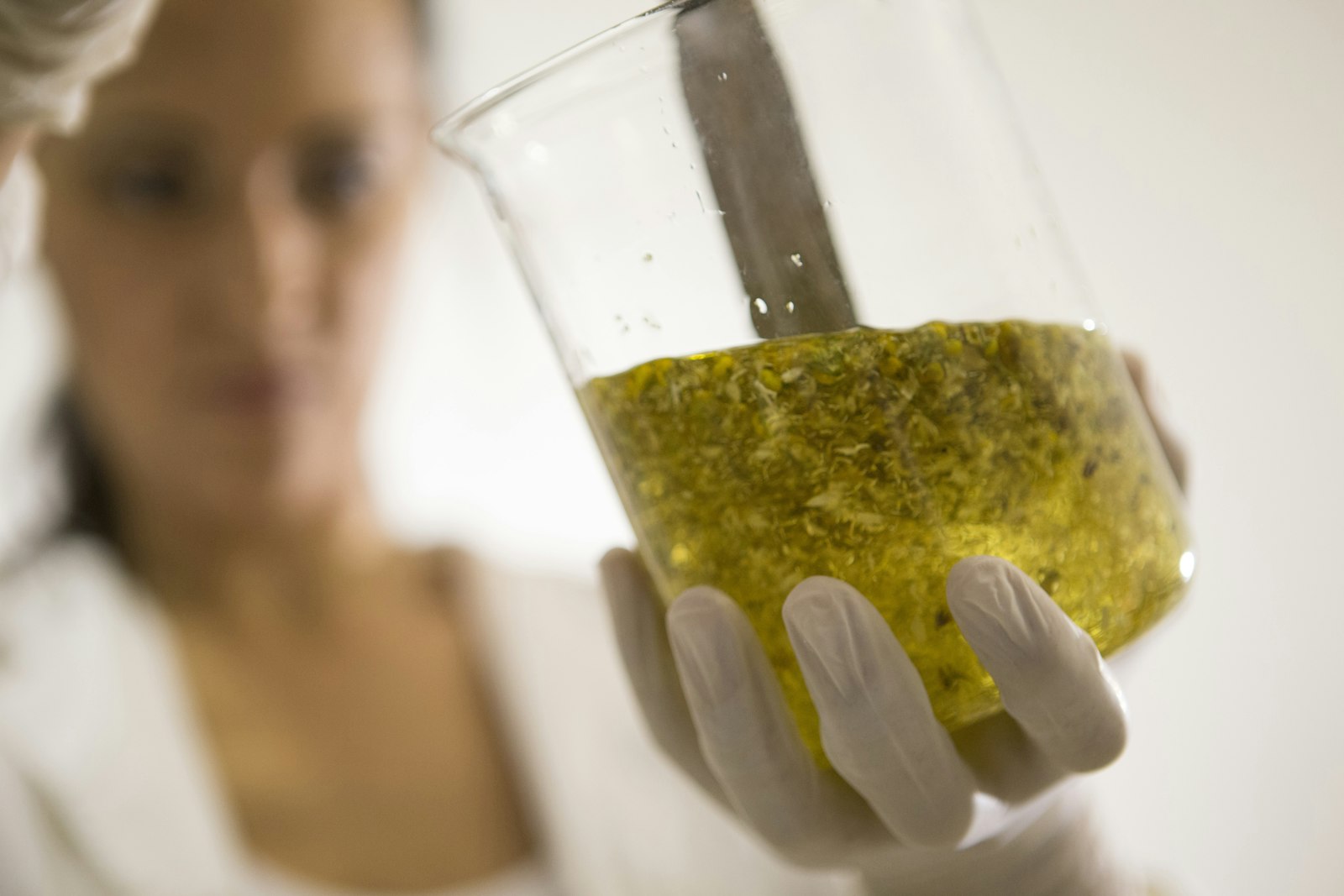
Colour is the most honest indicator you have. Check your serum against white paper in daylight before you apply it.
A light yellow tint is normal and does not mean the product is finished. Some formulas are tinted from the outset by other ingredients, and ferulic acid in particular yellows as it ages without necessarily taking the vitamin C with it. Deep amber is a different matter. At that point the antioxidant capacity is largely spent, and you are applying an acidic, slightly sticky liquid with very little of the benefit intact.
Heat and light, in that order
Oxidation is a chemical reaction, and chemical reactions accelerate with temperature. In broad terms, every rise of ten degrees roughly doubles the rate. A serum kept at twenty degrees in a European bedroom and the same serum kept at thirty two degrees on a windowsill in Bangkok are not on the same timeline. The second bottle may have weeks where the first had months.
Light does its own damage independently. Ultraviolet and visible light both drive the reaction, which is why serious vitamin C products arrive in amber glass, opaque aluminium or airless pumps, and why a clear bottle on an open shelf is a poor sign regardless of what is inside it.
Storing a serum in a hot flat
Keep it in a cupboard or a drawer, not on the counter beside the basin. Bathrooms are the hottest and most humid room in most Thai homes.
The door shelf of the refrigerator is a reasonable option for L-ascorbic acid. Cold slows oxidation considerably. Let the product come up to room temperature for a minute before applying so it spreads properly.
Buy the size you will finish in three months, not the value size you will finish in eight.
pH, stinging and the tolerance question
L-ascorbic acid needs a pH below about 3.5 to cross the skin barrier in useful quantity. That acidity is the reason a high strength vitamin C serum can sting, particularly around the nose and on skin that has recently been exfoliated, shaved or exposed to sun. A brief tingle that settles within a minute is common. Persistent burning, redness that lasts, or a tight stripped feeling afterwards is a signal to reduce concentration or frequency rather than to persevere.
This is where climate matters again. Skin in a hot, humid environment is often already dealing with sweat, friction, sunscreen worn for twelve hours a day and frequent cleansing. Layering a pH 3 serum on top of all that is more provocation than many people need. A fifteen per cent formula used every morning is not automatically better than an eight per cent formula used every morning without irritation. The best concentration is the highest one your skin accepts without complaint.
If you are starting out, apply every other morning for two weeks, then daily. If you use acids or a retinoid, keep them on separate parts of the routine, vitamin C in the morning and the retinoid at night, rather than stacking them.
It works with sunscreen, not instead of it
Sunscreen absorbs or reflects ultraviolet radiation before it reaches the skin. It is very good at this and it is not perfect. The radiation that does get through, along with visible light and pollution, generates free radicals in the skin. A topical antioxidant supports the skin against that oxidative load. The two work at different points in the same sequence.
So vitamin C does not replace SPF, it does not carry an SPF value, and no antioxidant serum should be treated as sun protection. What it does is make a good sunscreen routine more complete, which in a country with a high UV index for most of the year is a reasonable thing to want.
"Think of sunscreen as the shutters and antioxidants as the cleaning up of whatever light gets past them. You want both, and neither substitutes for the other."
Morning or evening
The traditional recommendation is morning, so the antioxidant is in place during the hours of exposure. That logic holds. Ascorbic acid also remains in the skin for a considerable time after application, so an evening application is not wasted.
In practice, choose by routine rather than theory. If your mornings are rushed and you apply serum, wait and sunscreen in ninety seconds, an evening application may simply be better executed. If you use a retinoid at night, morning vitamin C keeps the two apart and avoids compounding irritation. Either is defensible. Consistency outperforms optimisation.
Knowing when to stop using it
There is no need to guess. Write the opening date on the bottle in marker. Then apply three checks.
Colour. Hold it against white paper in daylight. Deep amber or brown in an L-ascorbic acid formula means the useful life is over.
Smell. Oxidised vitamin C develops a flat metallic or faintly sour note. A fresh formula smells of very little.
Feel. Increased tackiness, a syrupy texture or a product that no longer absorbs is a sign of degradation.
As a working rule, treat an opened L-ascorbic acid serum as good for around three months in this climate, less if it has been stored warm, longer if refrigerated. Stable derivatives will comfortably manage six to twelve months. Discard rather than persist. An oxidised serum is not merely inactive, it is a pro-oxidant, which is the opposite of the reason you bought it.
A short summary
Buy small, store cool and dark, close the cap, choose a concentration your skin tolerates rather than the highest number available, use it under sunscreen and not instead of it, and replace it when the colour tells you to. Vitamin C is a reliable ingredient. It simply asks for conditions, and in a tropical climate those conditions have to be arranged deliberately rather than assumed.


